November bombing of Město
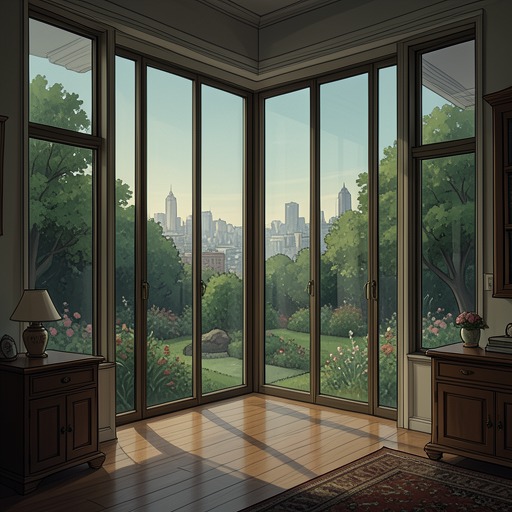
The Glass RoomThe November bombing of Město is a sudden air raid in which the city’s obscuring fog offers no warning or protection: bombs fall without an alarm, tearing through streets and buildings and nearly destroying the Landauer House. The attack leaves the house standing but breaks the Glass Room’s plate-glass walls and wounds Laník’s sister’s hearing. Its passage from a false alarm to a near miss, then to a dimmed and patched-up home, makes survival depend on a fractionally different trajectory rather than on any promise of safety.
Causes and Setting
The episode opens on a cold November morning. Snow has gathered in street corners, and heavy fog hangs over Město, turning pedestrians into ghosts, vehicles into monsters, and buildings into castle keeps. The weather does more than establish the city’s wartime discomfort: it deadens sound, restricts movement, and carries cold into homes already short of fuel and food. The city feels starved and anaemic, its inhabitants pressed into queues and factory labour.
An air-raid siren sends people feeling their way through the fog to shelters and basements. They wait through prayers and curses until the all-clear sounds; the alarm proves false, and cautious routines resume. The later attack breaks that expectation. Bombs arrive without siren, engine noise, or visible sign, falling out of the fog so abruptly that the first explosion is mistaken for a gas blast, perhaps sabotage. The contrast between the false warning and the real bombardment makes the city’s attempts to anticipate danger seem helpless.
The Bombardment
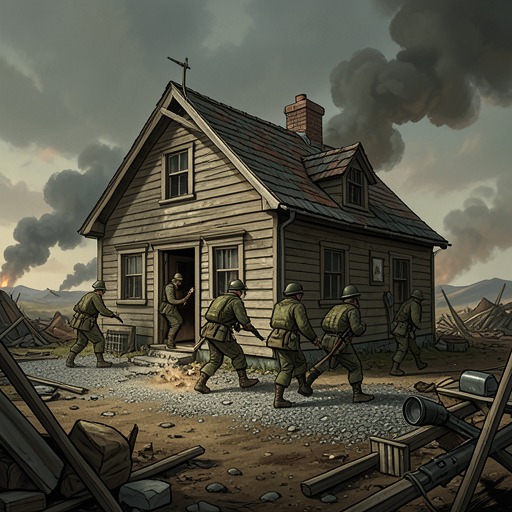
The explosions continue across Město, ripping up roads, hurling paving stones, and reducing churches, houses, shops, and part of the railway station to rubble. Shrapnel rattles over the tarmac. Dust and smoke thicken the fog, extending the morning’s obscurity into the aftermath. The narration renders the destruction not as a controlled military action but as force experienced from below: the city is trampled, and its ordinary places are suddenly exposed to violence without explanation.
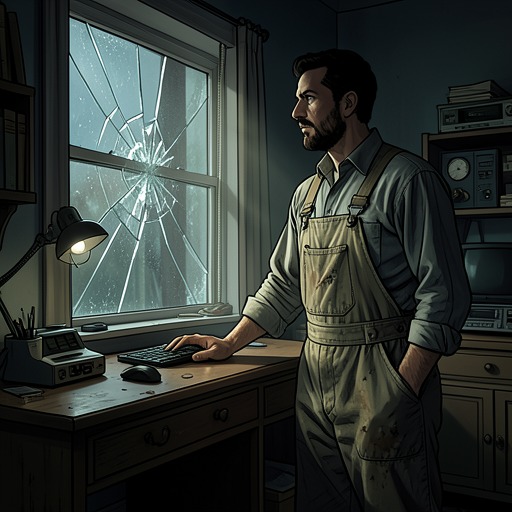
At the Landauer House, Laník and his sister are deep in the basement as a bomb drops toward them. She recites prayers and the litany of saints; he yells at her to stop. Neither hears the bomb’s approach, which is faster than its sound. They hear and feel the detonation instead, as the blast seems to enter their bodies. The building shudders to its roots, plaster and cement crack, and the Glass Room’s plate-glass windows flex and burst. The house’s defining transparent walls, conceived by Rainer von Abt, are transformed into flying fragments.
When the debris settles, the siblings let go of an instinctive embrace. Laník mutters that the bomb was close; his ears hum, while his sister weeps. He tells her that she ought to be glad they are alive. The immediate reprieve does not restore them to safety: when she says she cannot hear and describes only a noise like a train, the blast’s bodily cost becomes clear. The episode leaves that hearing loss as an injury rather than resolving it with the fact that the siblings survived.
The Near Miss at the House
Laník cautiously approaches the basement door and looks into the fog. He understands how narrowly the outcome was decided: a fractionally different parabola could have sent the bomb through the upstairs terrace, down through the ferroconcrete and the white space of the Glass Room, and into the basement. Five hundred pounds of high explosive might then have destroyed both the building and the people sheltering in it. Instead, the bomb lands in the garden, deep in wet earth.
Where a silver birch should stand, Laník sees the edge of a muddy crater, with smoke and steam rising from it and a sulphurous smell. His sister joins him, and he calls them bloody lucky. The crater makes luck tangible: the house’s survival is not proof that its glass, concrete, or refuge could withstand a direct strike, but evidence that the bomb fell just far enough away. The possibility of a different impact remains visible in the damaged ground and in the route the bomb did not take.
Damage and Aftermath
Later that day, Laník climbs to the terrace and looks inside. Scimitars of glass lie across the floor; the linoleum is torn, and dirt peppers the partition concealing the onyx wall. In the following days, he covers the broken windows with canvas tarpaulins. The Glass Room, once defined by light and transparent surfaces, is now shrouded in dusk. When sunlight enters through gaps in the coverings, it cuts through like blades of glass: light itself recalls the material the blast scattered across the house.
People at the pub blame the Americans, calling the raid the capitalist war machine’s random destruction of Město’s working people, but the account does not establish who carried it out. The uncertainty matters. The bombs are experienced as indiscriminate and their attribution remains uncertain, while their effects are concrete: ruined city buildings, a damaged modernist home, and an injured survivor. By the time Laník has patched the windows, the house remains usable but no longer offers the same luminous enclosure; its altered appearance preserves the raid’s violence in everyday space.
Significance
The bombing reverses the Glass Room’s promise of openness. Its great panes had made the house transparent, but during the attack they flex and explode, turning visibility into vulnerability. Afterwards, tarpaulins conceal the openings and reduce the room to gloom. The architectural ideal survives only in damaged form, with the house’s clean surfaces interrupted by torn linoleum, broken glass, dirt, and temporary coverings.
The scene also sets collective devastation against a sharply particular survival. Město’s churches, homes, shops, and railway station are struck, while the bomb that might have destroyed the Landauer House lands in the garden. That escape is neither earned nor secure; it is measured by the slight difference between two possible trajectories. Laník and his sister emerge alive, but she cannot hear normally, and their home is left exposed to cold and darkness. The event’s decisive change is therefore not simply from danger to safety: the immediate threat passes, while damage remains in the sister’s hearing, the broken windows, and the altered light of the Glass Room.